Verbs and Conjugations
- Published December 24, 2013
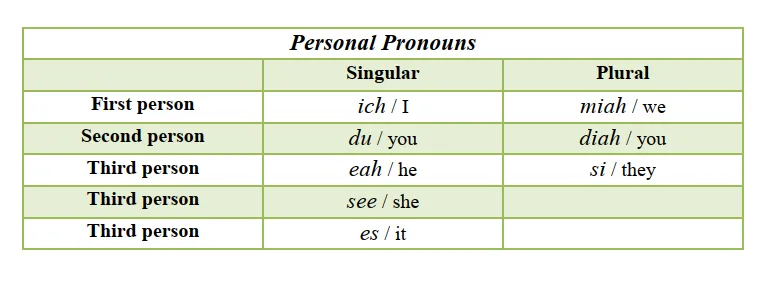
The chart below lists the nominative or subjective case of PA-German personal pronouns.
Personal Pronouns
Verbs - Present Tense
In most languages verbs change form, usually by adding different endings to make them agree with the subject in person (first, second, or third) and number (singular or plural). This is called conjugation. In English verbs don’t have as many different forms as some languages.
Example: I go, He goes.
In PA-German the verbs have many forms to agree with the subject in person and number.
The present tense forms of a PA-German verb are illustrated below.
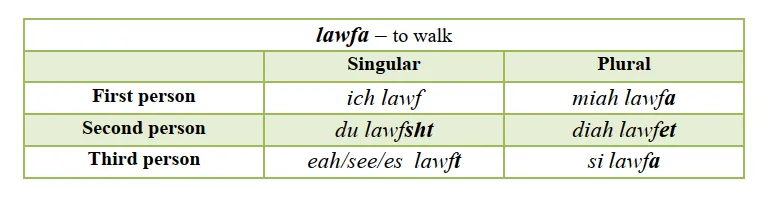
All PA-German verbs which follow the pattern shown above are called regular verbs. Verbs which do not follow this pattern are called irregular verbs.
The verb form given at the top - lawfa, is called the infinitive or dictionary form. It is the form you would find in a dictionary. The PA-German infinitive usually ends in a. The English infinitive is usually preceded by the word to. Thus, the PA-German infinitive lawfa, is equivalent to the English infinitive to walk.